


Hypertension (arterial hypertension) is high blood pressure that develops when blood circulation in the vessels is disturbed.The disease is diagnosed in many adults and occurs in varying degrees of severity.Why hypertension is dangerous, how to prevent the development of the disease and negative consequences - later in the article.
Concept and reasons
Hypertension or arterial hypertension is the name given to arterial pressure caused by changes in vascular tone.The disease affects both men and women equally often, mainly after the age of 40, but it also occurs in younger people.Hypertension is a fairly common disease and occurs in 40% of all adults.It is also one of the leading causes of death and disability from cardiovascular disease.
The main causes of hypertension are:
- atherosclerosis - age-related changes in blood vessels and their blockage with atherosclerotic plaques;
- excess weight, even in small amounts, can affect the condition of the blood vessels and the heart, which will lead to hypertension;
- emotional stress, tragic situations experienced, depression;
- nervous tension, problems at work;
- head injuries, concussion, hypothermia;
- hereditary predisposition - hypertension can manifest itself at a young age;
- some viral diseases (sinusitis, meningitis);
- menopause in women - hormonal changes in the body contribute to the manifestation of hidden diseases, against the background of which hypertension develops;
- a sharp increase in adrenaline in the blood;
- staying in front of a computer monitor for a long time;
- sedentary and sedentary lifestyle;
- eating large amounts of salt;
- rare exposure to fresh air;
- drink a lot of coffee;
- bad habits.
Symptoms
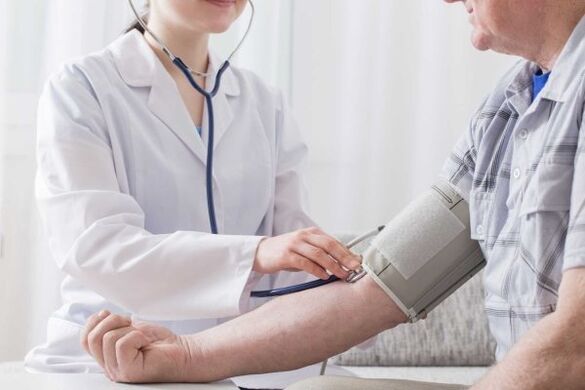
The main symptom is high blood pressure - 140/90 mmHg.Art.and higher.It is often accompanied by other symptoms.At the initial stage, they are neurotic in nature and show themselves:
- headache;
- tinnitus;
- "flies" flying in front of the eyes or blurred vision;
- disturbed sleep quality;
- dizziness;
- heaviness in the head;
- rapid heartbeat;
- general weakness.
Further development of the disease causes the following manifestations:
- nosebleeds;
- vomiting;
- the face turns red even with little effort;
- a feeling of pressure in the eyes - often forces patients to lie down with their eyes closed and wait for the attack to pass;
- swelling;
- memory impairment;
- feeling tired;
- problems with potency (in men).
Stages and classification
Doctors define 3 stages of arterial hypertension:
- The pressure periodically rises to 140/90 – 159/100 mm Hg.Art.After that, it returns to normal level independently.Often at this stage, a person is unaware of the disease.It can only be detected by constantly measuring the pressure and keeping a chart based on these readings.In the initial stage, complications are usually not observed, but there is still a risk of their development.Pressure increases cause insufficient blood supply to organs, which can later result in necrosis and stroke.Metabolic processes in the body are disturbed.Vasoconstriction causes cardiac overload and cardiac muscle hypertrophy.
- Pressure can rise to 160/100 - 179/109 mm Hg.Art.and now it does not return to normal without using the drug.In the second stage, accompanying symptoms begin to appear.The risk of developing complications increases;rated as medium (risk 2) and high (risk 3).This means that the risk of target organ damage over the next 10 years is 20-30%.
- The pressure rises to 180/110 and above and remains constantly high.An independent decrease in pressure at this stage may indicate a malfunction in heart function.The patient knows the symptoms very well, which prompts him to consult a doctor immediately.At this stage, damage to all internal organs and systems is observed.In advanced cases, it ends in death.Often, the 3rd stage of arterial hypertension requires urgent hospitalization in a hospital and the use of physiotherapeutic procedures in addition to drugs.At this stage, the medication is stable and is not canceled even if the condition improves.
Hypertensive crisis often occurs in the 2nd and 3rd stages of hypertension.
Depending on the causes of occurrence, there are:
- primary hypertension – when arterial hypertension develops as an independent disease;
- secondary hypertension – when hypertension is the result of another disease and requires the treatment of the primary disease as well.
There are 4 degrees of severity of hypertension:
- light or soft;
- average;
- severe, chronic;
- very heavy.
They differ according to the clinical course:
- benign hypertension - the pressure does not rise to a critical high level, hypertensive crises and target organ damage are rarely observed, the treatment has a positive result.
- malignant hypertension - the first manifestations are observed at a young age, are often accompanied by hypertensive crises and complications, and are poorly controlled with drugs.
Diagnostics
A number of laboratory and instrumental studies are conducted to make a diagnosis.Based on them, the doctor makes a conclusion about the degree of hypertension and the stage of its progress:
- The first and most important step in making a diagnosis is measuring blood pressure.You can do it yourself using a tonometer.In some cases, the doctor recommends daily monitoring of pressure changes, called the ABPM method.A special cuff is attached to the patient's shoulder, and a portable device is attached to his belt.During the day, the device measures the pressure every 15 minutes, at night - every 30 minutes.Diagnostics is carried out under normal human conditions.
- Blood and urine tests.Based on their results, the doctor evaluates the level of cholesterol, hemoglobin, hematocrit, glucose, creatinine, potassium and calcium.
- Then the condition of the target organs is evaluated:
- Physical examination.Sounds are heard, heart rhythm disorders are investigated, and the heart muscle is examined.
- EKG.In addition to the physical examination, an electrocardiogram is performed to assess the condition of the heart more accurately.
- Dopplerography.It is done to evaluate the patency of blood vessels.
- Arteriography.X-ray method to evaluate the condition of arteries, defects in their walls and the presence of atherosclerotic plaques.
- Examination of the fundus.At the initial stage of hypertension, vasoconstriction and retinal vascular dilation will be noticeable.In the second stage, aneurysms are noticeable and bleeding may occur.In the third stage, vision decreases and the condition of the optic nerve deteriorates.
- Ultrasound diagnosis of kidneys and adrenal glands.Kidney tissue damage is detected due to hypertension.
Treatment and prevention
Based on the diagnostic results, the doctor selects drug treatment for each patient individually.At the initial stage, lifestyle and weight adjustments are sufficient.Secondly, you can not do without medicine.In the third stage, a combination of drugs is selected and accompanying diseases are also treated.
Drug therapy
Hypertension is often treated with a prescription for:
- Thiazide diuretics - reduce blood pressure by removing fluid from the body.
- Sartans (angiotensin II receptor blockers) are a new generation of drugs that lower blood pressure throughout the day and require a dose in the morning or evening.
- Calcium antagonists - should be used for accompanying heart disorders (arrhythmia, angina pectoris, cerebral atherosclerosis).
- Angiotensin-converting enzyme inhibitors - expand blood vessels and arteries, preventing their spasm.
- Beta blockers - normalize the rapid heart rate that occurs in response to increased blood pressure.
- Alpha-adrenergic receptor blockers - used to expand peripheral blood vessels;drugs have a mild effect.
All drugs have side effects, so self-medication is unacceptable.
Lifestyle
It is impossible to treat hypertension without changing the lifestyle.First, we recommend:
- get rid of bad habits;
- avoid stress and emotional stress;
- avoid excessive physical activity in the gym;
- preference should be given to running, swimming, gymnastics, race walking and cardio exercises;
- increase rest time, pay attention to sleep quality;
- spend more time in the fresh air (long walks in the park, forest plantations, near water bodies will be useful).
Traditional methods
Folk remedies are widely used in the treatment of hypertension.However, you should not forget that you should follow a healthy lifestyle, your doctor's recommendations and use them in addition (do not replace drug treatment with them).
Traditional treatment should be used for a long enough time.The effect can be expected after several courses lasting 2-3 months with 10-day intervals.
The best recipes and traditional methods for the treatment of hypertension:
- Recipe 1. You need to take: 250 g of honey (preferably rose honey), 1 lemon, 2 cups of beet juice, 1.5 cups of cranberry juice, 1 cup of vodka.Mix all the ingredients.Take a spoon on an empty stomach.
- Recipe 2. To prepare the infusion, you will need: 3 kg of onion juice, 0.5 kg of honey, 30 walnut partitions, 0.5 liters of vodka.Mix onion juice and add walnut partitions with honey and pour vodka.Leave for 10 days.Take the infusion 1 tablespoon 3 times a day.
- Recipe 3. A mixture of 0.5 cups of chopped beets and the same amount of honey.A course of 3 months, take 1 tablespoon before meals 3 times a day.
- Motherwort.It has a calming effect on the nervous system and relaxes the walls of blood vessels.The plant is brewed and taken as tea.
- mintHelps to overcome nervous tension.The leaves of the plant are added to tea.
- Chokeberry is widely used in the treatment of hypertension.You can use its berries to make jellies, compotes, syrups, jams and fruit drinks.You can take the fruit juice 3 times a day 30 minutes before meals.
- Traditional medicine recommends using bee venom to normalize blood pressure.For this, bees sting their limbs twice a week.Bee venom dilates blood vessels, closes spasms in them, has diuretic properties.
People often have an allergic reaction to bee venom or honey.In case of any unwanted reactions, the use of folk remedies with these components is contraindicated.
Folk remedies have sedative, diuretic, sedative and antispasmodic effects.They contain many vitamins and microelements, acids, which have a beneficial effect on the body and promote recovery in hypertension.

Diet
In addition to the above measures, a proper, balanced diet plays an important role.Patients with hypertension are recommended to exclude foods with bad cholesterol from the diet:
- fatty meat;
- salo;
- smoked meat;
- acid;
- fried foods;
- freshly baked bread.
Among the products needed by the body for hypertension:
- vegetables;
- fruits;
- berries;
- green;
- dairy products;
- legumes;
- lean meat, dietary classes;
- cereals
Products that should be restricted:
- Salt, it is better to buy salt with reduced sodium content.If possible, replace it with lemon juice, cranberries, cinnamon, cilantro or fennel.
- Liquid.The volume of fluid consumed per day should not exceed 1 liter.It includes not only water, but also compotes, soups, milk and teas.
- Caffeinated drinks.The goal is to reduce the stimulating effect on the cardiovascular system.
- Animal fats.It is allowed to consume up to 25 g per day.
- Sugar.Limit to 40 g per day.It contributes to the development of excessive atherosclerosis.
- Bread.It is recommended to use crackers or bread baked a few days in advance.
Prevention
People exposed to factors predisposing to the development of the disease:
- to follow a healthy lifestyle;
- continuously adhere to the recommended diet;
- take multivitamin preparations containing iron;
- regularly measure your blood pressure yourself;
- See a doctor periodically.
You can learn what hypertension is, the causes of its development, possible complications and how to control pressure with folk remedies and much more from the following video:
Complications
Hypertension is dangerous because it can cause diseases that cause disability and death.
Hypertensive crisis often develops.This is a sharp increase in pressure accompanied by deterioration of the patient's well-being.A hypertensive crisis can be caused by:
- strong psycho-emotional stress;
- one-time use of large amounts of alcohol;
- discontinuation of medication for hypertension or inadequate treatment;
- eating salt;
- meteorological factors.
During a hypertensive crisis, the patient experiences the following symptoms:
- lack of air;
- fear, anxiety;
- tachycardia;
- cold sweat;
- "goosebumps";
- hand tremors and internal tremors;
- redness of the skin on the face;
- dizziness;
- nausea and vomiting;
- numbness of lips, tongue;
- speech disorder;
- symptoms of heart failure (in complicated cases).
In case of a hypertensive crisis, the patient needs emergency medical care in a hospital setting.
Also, depending on the organ affected by lack of blood circulation, the following diseases may develop:
- heart failure;
- kidney failure;
- coronary insufficiency;
- bleeding, strokes;
- myocardial infarction;
- thrombosis;
- deterioration and loss of vision;
- loss of sensation in the limbs or paralysis.
Hypertension in the early stage can be completely treated.Then, as in the second, it causes serious complications and even death.Therefore, at the first manifestations of the disease, you should consult a doctor and do not neglect treatment and preventive methods.